
SPY 0DTE on Fed Day: The Split-Vote Hold and the Whipsaw Problem
The Fed held rates in a 10-2 split and stocks swung before closing higher. Here is what a Fed-day whipsaw does to bought SPY 0DTE calls and puts, and where the money is lost.
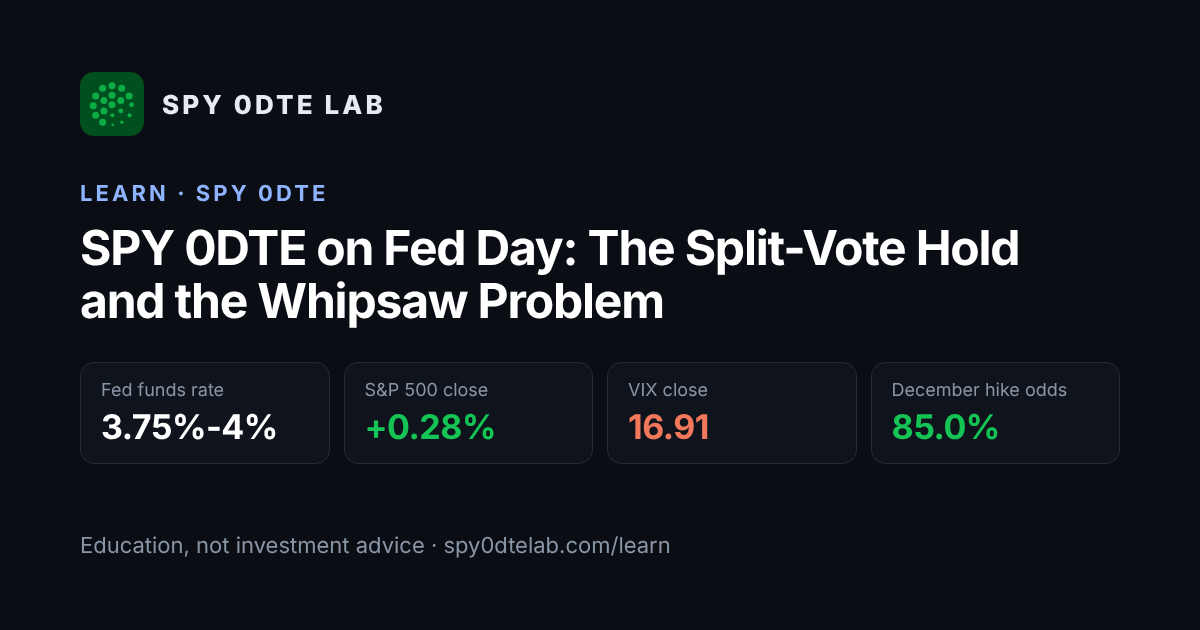
The Federal Reserve held its benchmark rate at 3.75% to 4% on Wednesday, October 28, 2026, but the vote was not unanimous. According to Bloomberg and CNN, two officials dissented in favor of a rate increase. Stocks swung back and forth after the decision and through Fed Chair Kevin Warsh's press conference, then finished the day higher.
For anyone who buys same-day SPY calls and puts, that kind of afternoon is a useful lesson. A market that ends up higher is not the same as a market that pays an option buyer. This article walks through what a Fed-day whipsaw does to 0DTE options, how to read trend versus chop, and where the losses come from.
What happened on this Fed day
According to Bloomberg and CNN, the Fed kept rates unchanged, as economists expected, in a 10-2 vote. Governor Cook and Cleveland Fed President Hammack wanted a 25-basis-point increase. A basis point is one hundredth of a percentage point, so 25 basis points is a quarter of a percent. The hold came one month after the Fed raised rates for the first time since 2023.
The statement did not clearly signal a hike in December. Policymakers wrote that "The accumulation of more information will help the committee determine the policy stance appropriate" to return inflation to 2%. Even so, CME's FedWatch tool showed markets pricing an 85.0% chance of a December hike, up from 78.3% on Tuesday.
Market reports put the S&P 500 up 0.28% at 7,743.98, after it had been up as much as 0.46% during the day. It was the first time the index closed higher on a Fed decision day since December 2025. According to StockTitan real-time data, SPY was up 0.3% in its last regular-session minute. The VIX, an index that measures the implied volatility of S&P 500 options over roughly the next 30 days, closed at 16.91, down 3.48%, according to Yahoo Finance.
Why Fed afternoons tend to chop
A Fed day has two news moments. First comes the decision and the written statement. Later in the afternoon, the chair answers questions at a press conference. Traders read the statement, place trades, then hear the chair's tone and sometimes reverse those trades.
A split vote adds fuel. Two dissents in favor of a hike tell the market that some officials want tighter policy. A statement that avoids promising a December move points the other way. When the news carries mixed signals, price often swings between interpretations before it settles. Reuters described the session as choppy, and that is a common shape for these days.
This matters because a same-day option has no time to wait out the chop. A swing trader can sit through a reversal and wait for tomorrow. A 0DTE buyer's option expires at the close, so every reversal eats into the only window the trade has.
What a whipsaw does to a bought call or put
When a trader buys a call, they pay a premium for the right to buy SPY at a set price, called the strike, until expiration. A put is the same idea in the other direction. The most a buyer can lose is the premium. The trade only makes money at expiration if SPY moves past the strike by more than the premium paid.
For example, take a call bought for $1.00, which costs $100 per contract because each contract covers 100 shares. SPY needs to finish more than $1.00 above the strike for that trade to profit at the close. If SPY rises early, falls back, then drifts up a little, the call may still expire worth less than $1.00 or worth nothing.
A hypothetical call with a $770 strike, bought for $1.00 ($100 per contract). Below the strike the whole premium is lost; the trade only gains above $771, the strike plus the premium. Round, made-up numbers.
Three forces work against a buyer in a whipsaw:
- Theta, the daily loss of an option's time value. On expiration day it is at its steepest, so every minute of sideways action costs money.
- Gamma, the rate at which an option's sensitivity to price changes. Near expiration it is high, so a reversal can cut an option's value in half within minutes.
- Implied volatility, the market's priced-in expectation of future movement. Before a scheduled event it is often elevated, and once the news is out it can fall. The VIX dropped on this Fed day. The VIX tracks a longer horizon than same-day options, but the direction illustrates the idea: less uncertainty usually means cheaper options.
Trend day or chop day: reading context
A trend day is one where price moves mostly in one direction and pullbacks are shallow. A chop day is one where price swings up and down without going far. Option buyers generally need trend, because only a sustained move outruns the premium and the decay.
Many traders use VWAP as context. VWAP, the volume-weighted average price, is the average price traded so far that day, weighted by how many shares changed hands at each level. On a trend day, price often stays on one side of VWAP. On a chop day, it crosses back and forth. Moving averages, which smooth recent prices over a set number of bars, serve a similar purpose: when they flatten and tangle together, the market is going sideways.
A breakout is a move beyond a recent high or low. On event days, many breakouts fail: price pushes past a level on the headline, then snaps back. The S&P 500 reaching a 0.46% gain and closing at 0.28% is a modest example of a move that gave some ground back. None of these tools predict the close. They describe what price has done, which helps a trader judge whether conditions look more like trend or more like chop.
Sizing by risk and handling fast losses
Sizing by risk means deciding first how much money a single trade can lose, then choosing a position size that fits that loss. For a bought option, the honest number is the full premium, because a 0DTE option can and often does expire worthless.
Event days stretch this further. Fills can be worse when prices move fast, and the spread between bid and ask can widen. A trader who sizes as if the worst case is a partial loss may find that the worst case arrived in ten minutes.
The psychology is its own risk. A fast loss right after the statement invites a revenge trade on the press conference, often bigger and less planned. FINRA retired the pattern day trader rule on June 4, 2026, so there is no longer an outside cap on day-trade frequency for smaller margin accounts. Any brake on overtrading now has to be part of the trader's own written rules.
The day after: earnings gaps and settlement
Fed day was not the only event. After the close, big technology companies reported. According to the day's reports, Microsoft rose 2.63% after hours on revenue that beat estimates, while Alphabet fell about 10% on its first top- and bottom-line miss in nearly four years. Those moves can show up in SPY at Thursday's open.
S&P 500 high and close, and the VIX, on October 28, 2026; Microsoft and Alphabet in after-hours trading (Alphabet about 10%). Sources: Bloomberg, CNN, Yahoo Finance and the day's earnings reports.
That links to settlement. SPY options are American-style and settle into shares. A bought call or put left open and in the money at the close is usually exercised automatically into 100 shares per contract, long for a call and short for a put. That position then sits through the night, exposed to exactly the kind of after-hours moves seen on Wednesday. Many 0DTE buyers treat closing before the bell as part of the plan for that reason, but the choice and its cost are each trader's own.
How the SPY 0DTE strategy meets days like this
Our SPY 0DTE strategy buys same-day SPY calls and puts in a real-money account. Its entries follow fixed rules applied to live market data, so how it treats an event day is decided by its rules in advance, not by a fresh guess about the headline. Exits are our own decisions. Every closed trade, winners and losers, is on the public record on the site.
Days like this show why rules matter for a buying strategy. A whipsaw punishes improvised entries, oversized positions and revenge trades, and it does so quickly. Rules do not remove those losses. Bought options still expire worthless, and a choppy event day can produce a loss even when the index closes up. What rules can do is make the behavior on those days consistent and reviewable.
For readers who want to study how a rules-based approach to buying same-day SPY options is structured, the SPY 0DTE Playbook is a PDF that explains the method in full. It is education about a method, not a promise of results, and past trades do not predict future ones.
Frequently asked questions
Why does SPY often swing back and forth after a Fed decision?
The market digests the news in stages. The rate decision and the statement come first, then the chair's press conference adds tone and detail. Each stage can push prices in a different direction before traders settle on a view.
Can a 0DTE call lose money even if SPY closes higher?
Yes. If SPY does not rise above the strike plus the premium paid by the close, the trade loses money. A small gain, like the roughly 0.3% move in SPY on this Fed day, may not be enough to cover the cost of an option bought earlier in the session.
What is an implied volatility drop after an event?
Before a scheduled event, option prices often include extra value for the uncertainty. Once the news is out, that uncertainty is gone, and option prices can fall even if the underlying price has not changed much. Traders often call this a volatility crush.
What happens if a bought SPY 0DTE option is in the money at the close?
SPY options are American-style and settle into shares. An in-the-money option left open at expiration is usually exercised automatically, which turns each contract into 100 SPY shares or a short position of 100 shares. That position then carries overnight risk, which can be large when big earnings reports land after the bell.
Does the end of the pattern day trader rule change anything for 0DTE buyers?
FINRA retired the pattern day trader rule on June 4, 2026, so smaller margin accounts no longer face that limit on the number of day trades. That removes an outside brake on how often a trader can trade. Any limit on frequency now has to come from the trader's own rules.
This article is general, educational information, not investment advice or a recommendation to buy or sell any security. Options, especially same-day options, involve substantial risk and can lose their full value within minutes. Past results do not guarantee future results. Read the Risk Disclosure.