
SPY Options Bot on News Days: Lessons From Alphabet's Earnings Miss
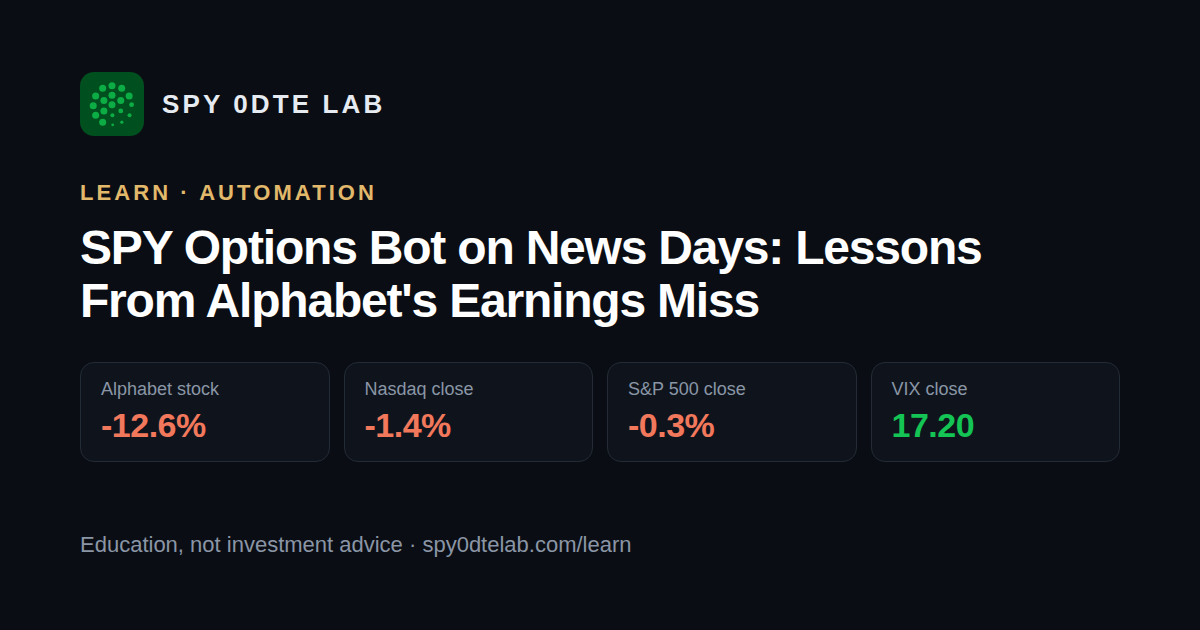
Alphabet's worst day ever pulled the Nasdaq down 1.4% while most S&P 500 stocks rose. Here is how an AI-built SPY options bot can be designed and tested for news-driven days.
On Thursday, Oct 29, 2026, Alphabet had its worst day ever. The stock fell about 12.6% after third-quarter earnings came in well below forecasts, according to CNBC and StockTitan, and it lost about $500 billion in market value. The Nasdaq fell 1.4%. The S&P 500 slipped only about 0.3%, even though 390 of its stocks rose, by TheStreet's count.
For anyone building a SPY options bot with an AI coding assistant, this is a useful day to study. The news landed after the close, the damage was narrow, and the next morning brought more data and more earnings. This article walks through what a day like this asks of an automated system: knowing the calendar, checking its data, stopping itself, and being tested against days that do not look normal.
What happened: a big miss and a narrow selloff
Alphabet reported after the close on Wednesday, Oct 28. Earnings were $2.12 per share, against the roughly $3.01 to $3.02 analysts expected, according to MarketBeat and Schwab. Free cash flow was more negative than expected, and the company kept its full-year spending plan unchanged. Fears about AI spending came back, and chip, AI and software stocks sold off. Microsoft, which reported the same afternoon, held up better and slipped 0.16%. ServiceNow fell about 25% and Fortinet about 21% after their own reports, according to Yahoo Finance.
Breadth means how many stocks take part in a move. Thursday's breadth was positive: TheStreet found only three sectors down, communication services, technology and energy. The Dow fell 0.25% to 52,342.56. The VIX, an index of the volatility the options market expects for the S&P 500 over the next 30 days, closed at 17.20, up 1.71% from 16.91. That is a small rise for a day with a record single-stock drop. None of the sources gave a SPY-specific number.
Closing moves on Oct 29, 2026, in percent. Sources: Yahoo Finance, StockTitan, CNBC and Schwab.
Why one company's report reaches SPY
SPY is an exchange-traded fund that tracks the S&P 500. The index is weighted by market value, so the largest companies count the most. When one of them loses hundreds of billions of dollars in a day, the index feels it even while most of its members rise.
For a 0DTE trader, meaning someone trading options with zero days to expiration, this widens the risk calendar. It is not only Fed meetings and economic reports. Earnings from the biggest companies are SPY events too, and they usually arrive after the close. The options that expired that afternoon are gone, and the next day's options open with the news already in the price.
Different structures feel this differently. An iron condor sells a call spread above the market and a put spread below it and collects a premium; it profits if SPY stays between the short strikes and loses if SPY moves past them. A strategy that buys options needs a move big enough to beat the premium paid. Either way, a bot that assumes every day is ordinary can be wrong before it sends its first order.
The overnight gap and the morning check
After-hours trading happens after the 4 PM close. On Thursday evening, Amazon fell as much as 10% after hours before recovering some of the loss, and kept its 2026 AI spending plan at $220 billion, according to Yahoo Finance. Intel ended after-hours trading 23% lower after a weaker forecast, according to StockTitan. Friday morning brings the Employment Cost Index, a measure of labor costs, plus earnings from Exxon Mobil, Chevron and AbbVie before the open, according to Benzinga.
A common design answer is a pre-open checklist written in code, so the bot looks at the world before it acts:
- An event calendar file listing scheduled economic releases and earnings dates for the largest index members, kept up to date by a person.
- A gap check that compares the pre-market price with the prior close.
- A volatility check that reads current implied volatility or the VIX live, not a cached value from yesterday.
- A written rule for what the bot does on a flagged day, decided long before the morning it applies.
The exact rule matters less than when it is decided. Choosing what to do at 9:31 after seeing a record drop is where improvised judgment creeps into a system meant to follow rules.
Kill switches and data guards
A kill switch is any control that stops a bot from sending new orders when something is wrong. News days test these controls because quotes move fast, bid-ask spreads widen and broker connections can lag. Typical guards include:
- A daily loss limit that stops new orders and sends an alert.
- An order count limit that catches a loop sending the same order again and again.
- A stale-data guard that refuses to trade on quotes with old timestamps.
- A spread guard that blocks orders when the gap between bid and ask is unusually wide.
- A manual off switch that works even if the main program is frozen.
Illustration with round made-up numbers: an open position gains early, a news shock hits at noon, and a hypothetical $600 loss limit closes it and stops trading. Not a real trade.
Stopping a bot does not close what it already holds. SPY options are American-style and settle into shares. A short option left open into the close can be assigned and become a share position overnight, exposed to exactly the kind of after-hours shock Amazon and Intel showed on Thursday.
Testing against days that do not look normal
Three tools cover different gaps. A backtest runs rules over historical data. A replay feeds recorded market data through the bot as if it were live. Paper trading sends simulated orders using live data. Each can mislead: backtests and paper fills often assume prices near the middle of the spread, while real fills on a shock day can be much worse.
A day like Thursday makes a good replay case because it was calm at the index level and violent underneath. Useful questions to answer from the logs:
- Did the bot read the event calendar and apply its flagged-day rule?
- Did loss limits trigger at the expected level, and only once?
- What happened when a quote went stale or the broker API disconnected?
- Was any position left open at the close, and what would assignment have meant?
- Did the logs record every decision with a time and a reason?
Reviewing what the AI assistant wrote
AI coding assistants write plausible code fast. Plausible is not the same as correct, and news days expose the difference. Common weak spots in generated trading code:
- Time zones: economic data comes out at 8:30 a.m. Eastern, while many servers run on UTC.
- Retry loops that resend an order after a timeout and create duplicates.
- Error handling that quietly swallows an exception and keeps trading.
- Hard-coded dates and holiday calendars that go out of date.
- Position tracking from the bot's memory instead of the broker's account records.
A practical habit is to read every function that sends or cancels an order line by line, ask the assistant to explain each branch, and write tests that force failures on purpose. This matters more now. FINRA retired the pattern day trader rule on June 4, 2026, which removed one account-level brake on frequent trading, so the limits inside the bot carry more weight.
How the auto-trading prompts meet days like this
We run two automated strategies, the Iron Condor strategy and the SPY 0DTE strategy, in a real-money account. Entries follow fixed rules on live data. Exits are our own decisions. Every closed trade is on the public record. Earnings days, data releases and volatile sessions are handled by rules fixed in advance, not by reactions in the moment.
The Iron Condor Auto-Trading Prompt and the SPY 0DTE Auto-Trading Prompt are PDFs, $899 each, written to guide an AI coding assistant through building your own bot around those rules: broker API connection, paper trading, replay and backtesting, kill switches, news-day handling and code review. They do not remove risk. The code, the testing and the account remain yours to supervise, and losses are possible on any day.
Frequently asked questions
Why did the S&P 500 fall when most of its stocks rose?
The S&P 500 is weighted by market value, so the largest companies count the most. Alphabet lost about $500 billion in value in one day, and chip, AI and software stocks also fell. That outweighed gains in the 390 stocks that TheStreet counted as rising.
Can an earnings report after the close affect same-day SPY options?
Options that expired that day have already stopped trading by the time most reports come out. But SPY options are American-style, and holders can still decide to exercise for a short time after the close, so after-hours news can affect assignment. The next day's options also open with the news already priced in.
What is a kill switch in a trading bot?
It is code, or a manual control, that stops the bot from sending new orders when something goes wrong. Common triggers are a daily loss limit, too many orders, stale data or a lost connection. Stopping the bot does not close open positions by itself, so the design has to say what happens to them.
Can paper trading show how a bot handles a day like this?
Partly. Paper trading uses live data with simulated orders, so it tests the logic and the connection to the broker. It often fills orders more kindly than a real market does when spreads widen, so it can make a shock day look less costly than it would be.
Is code written by an AI coding assistant safe to run with real money?
Not without review. Assistants write plausible code quickly, but plausible is not the same as correct, and trading bugs can lose money fast. Reading every order-sending function, testing failure cases and running replays and paper trading first all reduce, but do not remove, that risk.
Do your strategies trade on earnings days or data days?
We do not say how our strategies behave on any kind of day. Such days are handled by rules fixed in advance. Entries follow fixed rules on live data in a real-money account, and every closed trade is on the public record.
This article is general, educational information, not investment advice or a recommendation to buy or sell any security. Options, especially same-day options, involve substantial risk and can lose their full value within minutes. Past results do not guarantee future results. Read the Risk Disclosure.