
Intel and Amazon Sell-Off: A Trend Day Test for SPY 0DTE Iron Condors
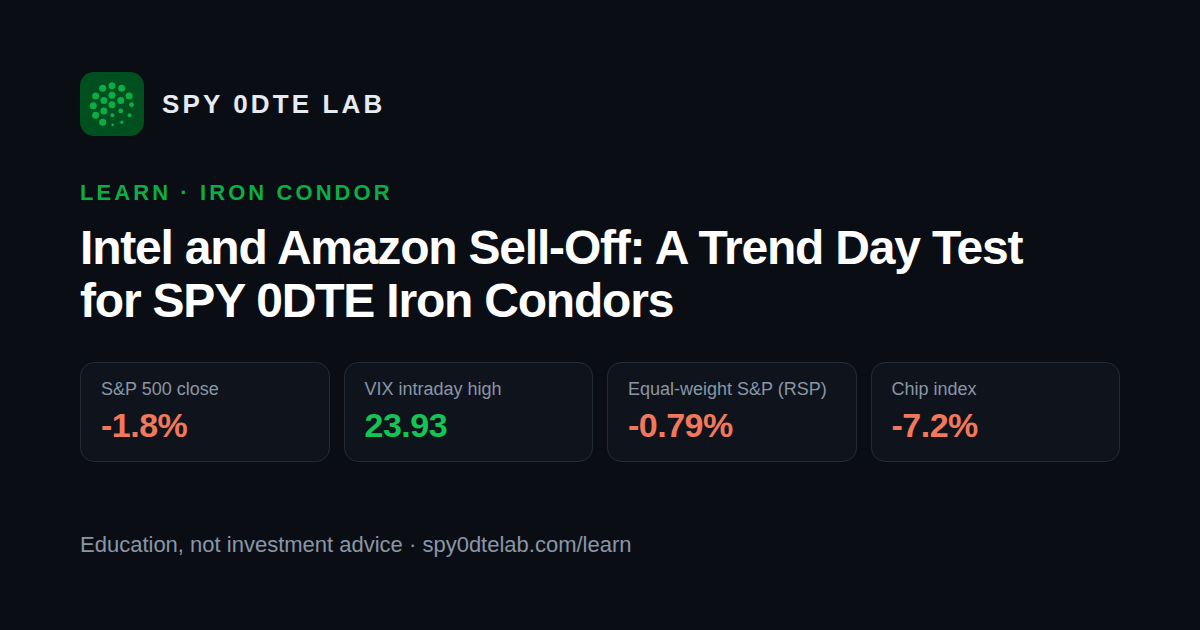
Intel and Amazon earnings pulled the S&P 500 down 1.8% and sent the VIX to 23.93 intraday. What a one-way trend day means for SPY 0DTE iron condors and credit spreads.
Intel and Amazon reported results after the close on Thursday, October 29, and on Friday the tech trade broke. According to Reuters, Intel closed down about 28.6% and the Philadelphia chip index fell 7.2%. According to AP, the S&P 500 lost 140.32 points, or 1.8%, to 7,580.07, its worst day since June.
For traders who sell SPY same-day iron condors, a day like this is the classic hard case. The move starts with overnight news, keeps going in one direction, and lifts volatility along the way. This article walks through what happened, why a narrow sell-off still moved the whole index, and where a short-premium position takes damage on a one-way day.
What happened: two earnings reports, one direction
According to CNBC and 24/7 Wall St., Intel beat on earnings but gave a weak fourth-quarter forecast, blaming slow PC sales. SiliconANGLE reported that Amazon missed on both revenue and earnings, and that its free cash flow is getting more negative as it spends heavily on cloud and AI.
The selling spread from there. Reuters reported Nvidia down 4.2% and AMD down 10.9%, with server makers Dell down 10.8% and HP down 9.6%. The chip index is now down more than 15% for October. The Nasdaq lost 2.9%, its biggest one-day drop since June 5, and the Dow fell 1.1% to 51,770.31. Reuters added that October ends with the S&P 500 and Nasdaq down for the month and all three indexes down for the week.
Closing moves on Friday, October 30, 2026. Sources: Reuters via Yahoo Finance, AP, CappNotes.
One caveat: the sources give figures for the S&P 500 index, not for the SPY ETF itself. SPY tracks the index, so its move was similar, but exact SPY figures are not part of this record.
A narrow sell-off with a wide footprint
The most telling number of the day is a quiet one. According to CappNotes, the equal-weight S&P 500 ETF (RSP), which gives every company the same weight, fell only 0.79%. The regular S&P 500 fell 1.8%, more than twice as much.
The gap comes from how the index is built. The S&P 500 is cap-weighted: each company counts in proportion to its total market value. A handful of very large tech companies make up a big share of it. When they fall hard together, the index falls hard even if the typical stock has a mild day.
SPY follows the cap-weighted index. So for a SPY option trader, the market on Friday was mostly a few giant tech names. An iron condor on SPY is in effect a bet that the index stays inside a range, and that range can be broken by a small group of companies reporting earnings, not only by a broad economic shock.
This is why earnings season matters to index traders who never touch a single stock. When the biggest companies report, their overnight news can become the index's next-day move.
Why a trend day is the iron condor's hard case
An iron condor is four options with the same expiry. It sells one put and one call, both out of the money (away from the current price), and buys a put and a call further out as protection. The trader collects a credit up front. On a 0DTE trade, short for zero days to expiration, all four options expire the same afternoon.
The best case is a quiet day. SPY stays between the two short strikes, all four options expire worthless, and the credit is kept. The protective legs cap the loss. That is what defined risk means: the most that can be lost is the distance between the strikes minus the credit, and it is known before the trade.
Illustration with round made-up numbers: price starts near 600, short strikes at 590 and 610, long strikes at 585 and 615, $1.00 credit. Not a real trade.
A trend day attacks one side. On Friday the pressure was on the put side. As the index slides, the short put moves closer to the money. Its delta, how much the option's price moves for a $1 move in SPY, rises, and the spread's value climbs against the seller. On expiration day, gamma, the rate at which delta changes, is at its highest near the strike, so losses can speed up sharply once price gets close.
The call side gains as the market falls, but only a little. It was already cheap and can only fall to zero. In the example above, the most the trade can make is $100 and the most it can lose is $400. On a one-way day, the losing side decides the result.
Volatility rose fast, then partly faded
Volatility added a second layer. The VIX is a measure of the 30-day implied volatility priced into S&P 500 options. According to Yahoo Finance and Cboe, it closed at 19.42, up 2.22 points or 12.91%. Investrade reported that it hit 23.93 in the afternoon, and TheStreet said it was up more than 32% at its intraday peak, the highest level since June.
Implied volatility is the price of uncertainty built into option premiums. When it jumps, options get more expensive, including the ones an iron condor is short. This sensitivity is called vega. For 0DTE options vega is small because little time is left, but a jump in volatility during a falling market still adds to the mark on the short put.
The afternoon spike and the softer close tell a common story. A short-premium position can look worst in the middle of the session, when price and fear peak together, and somewhat better by the close. A trader forced out at the worst moment, by a stop order, a margin call or nerves, locks in that price. A trader who holds takes the risk that the move continues. Neither choice is free.
Illustration only, made-up round numbers, not Friday's real price path. A price starting at 600 slides through a short put at 594 by midday, bottoms near 589, then recovers part of the drop.
Friday also showed why intraday numbers differ. Quartz reported the S&P down more than 2.3% and an Investing.com snapshot showed the VIX at 18.81. Those were readings taken during the session. For a 0DTE seller, the number that matters is the one on the screen at the moment a decision is made.
Overnight news, the 0DTE window and settlement
Intel and Amazon reported after the close. A 0DTE option opened on Friday morning was placed after the news was public, so the opening gap was already priced. Same-day trading does not carry risk from the night before into the session.
What it does carry is continuation risk. The news was known, but the reaction was not finished. On days like this, option prices usually reflect a larger expected move, so the same distance from the price pays more credit. That extra premium is payment for extra risk, not a gift.
Settlement adds its own risk on a Friday. SPY options are American-style, meaning they can be exercised at any time before expiry, and they settle into SPY shares, not cash. A short put that finishes in the money is normally assigned, which means buying 100 SPY shares per contract at the strike. If the long put also finishes in the money, it is normally exercised and the two offset.
Where the money is lost on a day like this
- The short strike is breached: near the strike on expiration day, high gamma makes losses grow quickly.
- Volatility expands: higher implied volatility raises the price of short options even before the strike is reached.
- Exits cost more: in fast markets the bid-ask spread, the gap between the buying and selling price, widens, so closing a position gives up extra money.
- The maximum loss happens: defined risk caps each trade, but a trend day can deliver that full cap.
- Settlement goes wrong: a close between the strikes can leave an unhedged share position over the weekend.
Premium selling tends to win small and often, and lose large and rarely. Days like Friday are the rare part. Any honest view of the approach has to count them.
How the Iron Condor strategy meets days like this
The Iron Condor strategy sells SPY same-day iron condors in a real-money account. Its entries follow fixed rules on live data, and earnings-heavy sessions, volatility spikes and other event days are handled by rules fixed in advance. Exits are our own decisions. Every closed trade, winners and losers, is on the public record.
That record exists because of days like this one. A method that collects many small credits can give back a lot on one trend day, so the only fair test is the full history, bad days included.
For readers who want the complete written method, the Iron Condor Playbook is a PDF that documents it. It is education about a set of rules, not a forecast. Past trades do not predict future ones, and short options can lose several times the credit they collect.
Frequently asked questions
Why did the S&P 500 fall more than the equal-weight version on October 30?
The S&P 500 is cap-weighted, so the largest companies count the most. According to CappNotes, the equal-weight ETF (RSP) fell 0.79% while the S&P 500 fell 1.8%. The difference shows the selling was concentrated in the biggest tech stocks.
Is an iron condor safe because it has defined risk?
Defined risk means the maximum loss is known before the trade: the width between strikes minus the credit received. It does not make the trade safe. On a strong trend day that maximum loss can be reached, and it is usually several times the credit collected.
What does a rising VIX do to a 0DTE iron condor?
A higher VIX reflects higher implied volatility, which raises option prices, including the options the iron condor is short. On expiration day this effect is smaller than for longer-dated options, but combined with a falling price it can push the short put's value up quickly. That shows up as an open loss even before the strike is touched.
Can a SPY 0DTE credit spread be assigned?
Yes. SPY options are American-style and settle into SPY shares. A short option that finishes in the money is normally assigned. If the price ends between the short and long strikes, the protective leg expires worthless and the share position from assignment is no longer hedged.
Does earnings news after the close affect 0DTE options opened the next day?
The news itself is already known when the next session opens, so the opening gap is priced in before a same-day trade is placed. What remains is the risk that the reaction continues through the day. Option prices on such days usually reflect that higher expected movement.
This article is general, educational information, not investment advice or a recommendation to buy or sell any security. Options, especially same-day options, involve substantial risk and can lose their full value within minutes. Past results do not guarantee future results. Read the Risk Disclosure.