
Intel's 29% Drop and a Trend Day: Lessons for SPY 0DTE Option Buyers
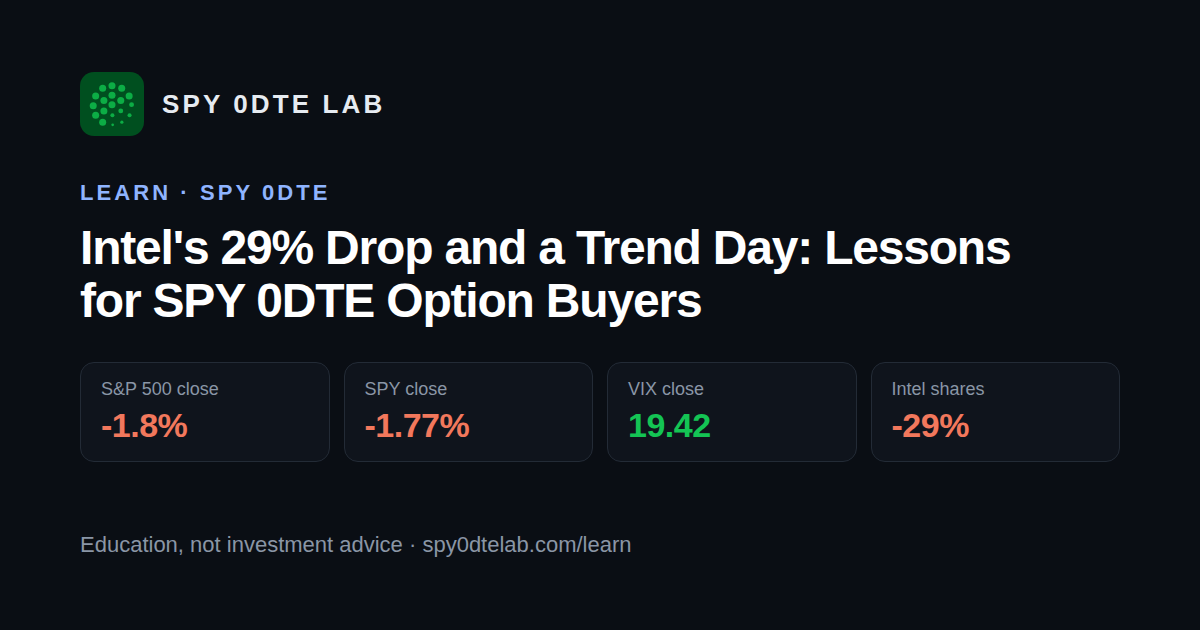
Intel fell 29% and SPY lost 1.77% on Oct. 30. What a one-way tech selloff shows about buying same-day SPY calls and puts: trend days, gamma, volatility spikes and fast losses.
Friday, Oct. 30, was the last trading day of October, and it was a rough one. According to the Associated Press, the S&P 500 fell 1.8% for its worst day since June, the Nasdaq composite lost 2.9% and the Dow Jones Industrial Average dropped 1.1%. The trigger was earnings. According to CNBC, Intel shares plunged 29%, their worst day since the 1970s, after weaker-than-expected guidance tied to a plant shutdown in Israel and soft PC demand. Amazon added to the pressure, closing at $240.35, down 1.41%, after its results missed revenue and earnings expectations.
For traders who buy same-day SPY options, a day like this is both the kind they hope for and the kind that hurts most when read wrong. This article uses Friday's selloff to explain trend days, how gamma and theta behave on expiration day, what a volatility spike does to option prices, and why losses on long 0DTE options arrive so fast. Markets are closed today, Saturday, and the next same-day session is Monday, Nov. 2.
What happened on Friday, in numbers
Most of the drop came from technology. According to the AP, the S&P 500 tech sector fell nearly 5% on the day. SPY, the exchange-traded fund that tracks the S&P 500 and the underlying for the options discussed here, closed down 1.77%. The selloff reached beyond Intel and Amazon. According to reports from Oct. 30, Sandisk fell 13.47% even after beating first-quarter forecasts, on concerns that memory pricing may be near a peak. The US government's 10% stake in Intel lost about $12 billion in value in a single day.
One caution. Sources disagree slightly on the S&P 500's exact close. The AP reported -1.8%, while other early reports printed different figures. Small gaps like this do not change the lessons, but they are a reminder that first-day numbers are often revised.
Daily percentage change on Friday, Oct. 30, 2026. Index figures are from the AP; the tech sector fell nearly 5%, shown here as -5.
Trend days and chop days for option buyers
A 0DTE option is one that expires the same day it is traded. Buying a call gives the right to buy SPY at a set price, the strike. Buying a put gives the right to sell at the strike. The buyer pays a price up front, called the premium, and that premium is the most the buyer can lose.
The buyer needs three things: a move, in the right direction, soon enough. On a trend day, price moves mostly one way with shallow pullbacks, and a well-timed put or call can gain many times its cost. On a chop day, price swings back and forth inside a range, and the premium bleeds away while nothing decisive happens. Most sessions are closer to chop than to trend.
Traders use a few tools as context, not as guarantees:
- VWAP, the volume-weighted average price, is the average price paid during the session, weighted by volume. Price holding on one side of it for hours often marks a trend.
- Moving averages, such as the average price of the last 20 bars, can show slope. Flat averages tend to go with chop.
- A breakout is a move through a prior high or low. A breakout that holds is a trend sign; one that quickly reverses is a classic trap for buyers.
The hard part is that a trend day is usually obvious only after the close. Early in the session it can look like ordinary chop. Buyers who bet on a bounce, or who bought puts late at inflated prices, could still lose their full premium on a day when the index fell almost 2%.
Gamma and theta on a one-way day
Delta is how much an option's price changes for a $1 move in SPY. Gamma is how fast delta itself changes. On expiration day, gamma is highest for strikes near the current price, so small moves in SPY change option prices quickly. On a trend day this works for the buyer: as SPY keeps falling, a put's delta grows and its gains accelerate.
The same force works in reverse. When a falling market bounces, a put's delta shrinks just as fast, and gains that took hours to build can vanish in minutes. A call bought to catch a rebound that never comes loses value on every leg lower.
Theta is time decay, the value an option loses as time passes. On expiration day it is steepest in the final hours. That means a pullback costs a buyer twice: price moves against the position, and the clock removes value at the same time. The chart below is a made-up example of a same-day put on a down day.
Illustration with round made-up numbers, not real prices: the put gains as the decline extends, peaks in an afternoon spike, then gives back a large share as the move fades and time runs out.
What a volatility spike does to option premiums
Implied volatility is the market's estimate of how much prices will swing, and it is built into every option price. When fear rises, premiums rise for both calls and puts. The VIX is a popular gauge of this: it measures expected 30-day volatility of the S&P 500, based on option prices. It is not the same as same-day implied volatility, but the two often move together.
According to CNBC data, the VIX closed Friday at 19.42, up 2.22 points or 12.91%, after hitting a high of 23.93 from a previous close of 17.20. One market review said the afternoon spike broke above the Oct. 16 high of 22.31 before the VIX settled just below 20.
VIX levels from CNBC and one market review: the prior close, the Oct. 16 high, Friday's intraday high and Friday's close.
For a buyer, this cuts both ways. A put bought early, before fear rose, gained from both the price drop and the jump in implied volatility. A put bought near the peak paid an inflated premium. When fear eased into the close, implied volatility fell, and that drop alone could shrink the option's value even if SPY held its level. Traders call this a volatility crush.
Fast losses, sizing by risk and the trader's head
The most a long option buyer can lose is the premium paid. On a 0DTE option, that full loss is not a rare event. It can happen within an hour. For example, a put bought for $1.00 might be worth $0.20 shortly after a sharp bounce, and nothing by the close. That is where money is lost: the move came too late, went the wrong way, or was already priced in.
Sizing by risk means starting from the dollar amount one accepts losing if the premium goes to zero, rather than from a number of contracts. Because a total loss of premium is realistic on expiration day, the premium paid is the risk. Many traders write this decision down before the session, when they are calm.
Fast losses also test the mind. Common patterns include revenge trading to win back a loss, chasing a move that has already happened, holding a losing option and hoping, and cutting winners too early out of fear. FINRA retired the pattern day trader rule on 2026-06-04, so small accounts no longer face a limit on frequent round trips. That removes a barrier, and it also removes a speed bump that once slowed down repeated trading after a loss.
Settlement, the weekend and the week ahead
SPY options are American-style and settle into shares, not cash. An option that finishes in the money is typically exercised automatically. A long put can become a short stock position and a long call a long stock position. On a Friday like Oct. 30, that position would carry over the weekend and face whatever gap opens on Monday.
The coming week is busy. According to CNBC, 138 S&P 500 companies report next week, including Apple, with Qualcomm and AMD also reporting. The midterm elections are on Tuesday, Nov. 3, and investors do not expect the vote to move the market much, since it remains tied to the AI trade and earnings. The October jobs report is due Friday, Nov. 6, and is expected to show 55,000 jobs added with unemployment steady at 4.2%, per FactSet. The ISM manufacturing and services reports also land that week. BTIG's chief market technician, Jonathan Krinsky, again warned that the S&P 500 is vulnerable to a selloff.
Scheduled events like these can produce trend days, but their outcome is unknown in advance, and option prices often already include some of the expected move. For a same-day buyer, that means the bar for profit is higher before the news, not lower.
How the SPY 0DTE strategy meets days like this
The SPY 0DTE strategy buys same-day SPY calls and puts in a real-money account. Its entries follow fixed rules applied to live data, its exits are our own decisions, and every closed trade is on the public record, wins and losses alike. Earnings selloffs, data releases and volatility spikes are handled by rules fixed in advance, not by judgment made in the heat of the day.
That is the main lesson of a day like Oct. 30. Trend days, chop, gamma, theta and volatility crush are all part of buying same-day options, and none of them can be predicted with certainty. The written rule framework behind our strategy is described in the SPY 0DTE Playbook, as education about how such rules are built. It is not a promise of results, and past records do not predict future ones.
Frequently asked questions
What is a trend day in SPY?
A trend day is a session where price moves mostly in one direction, with only shallow pullbacks. Friday, Oct. 30 had a strong one-way character for the index, with most of the damage in tech. The catch is that trend days are usually clear only after the close.
Why can a 0DTE option lose value even when the market moves my way?
Two forces work against a buyer. Theta, or time decay, removes value as the session runs down, and a drop in implied volatility makes premiums cheaper. If the move is too small or too slow, those forces can outweigh the gain from price.
What does the VIX tell a same-day option buyer?
The VIX measures expected 30-day volatility of the S&P 500, based on option prices. It is not the same as same-day implied volatility, but the two often move in the same direction. On Oct. 30 the VIX hit 23.93 before closing at 19.42, which shows how quickly fear can rise and fade.
What happens if a SPY 0DTE option is held to the close?
SPY options are American-style and settle into shares. An option that finishes in the money is typically exercised automatically, so a long put can become a short stock position and a long call a long stock position. On a Friday, that position would then carry over the weekend.
Does the end of the pattern day trader rule change anything?
FINRA retired the pattern day trader rule on 2026-06-04, so small accounts no longer face that limit on frequent round trips. That removes a barrier, but it also removes a speed bump that once slowed down repeated trading after a loss.
This article is general, educational information, not investment advice or a recommendation to buy or sell any security. Options, especially same-day options, involve substantial risk and can lose their full value within minutes. Past results do not guarantee future results. Read the Risk Disclosure.