
Futures Bounce Before a Big Week: Pre-Open Checks for an SPY Options Bot
Stock futures bounced on Sunday after a tech selloff, ahead of a week of data, earnings and elections. Here is what an automated SPY options bot checks before Monday's open.
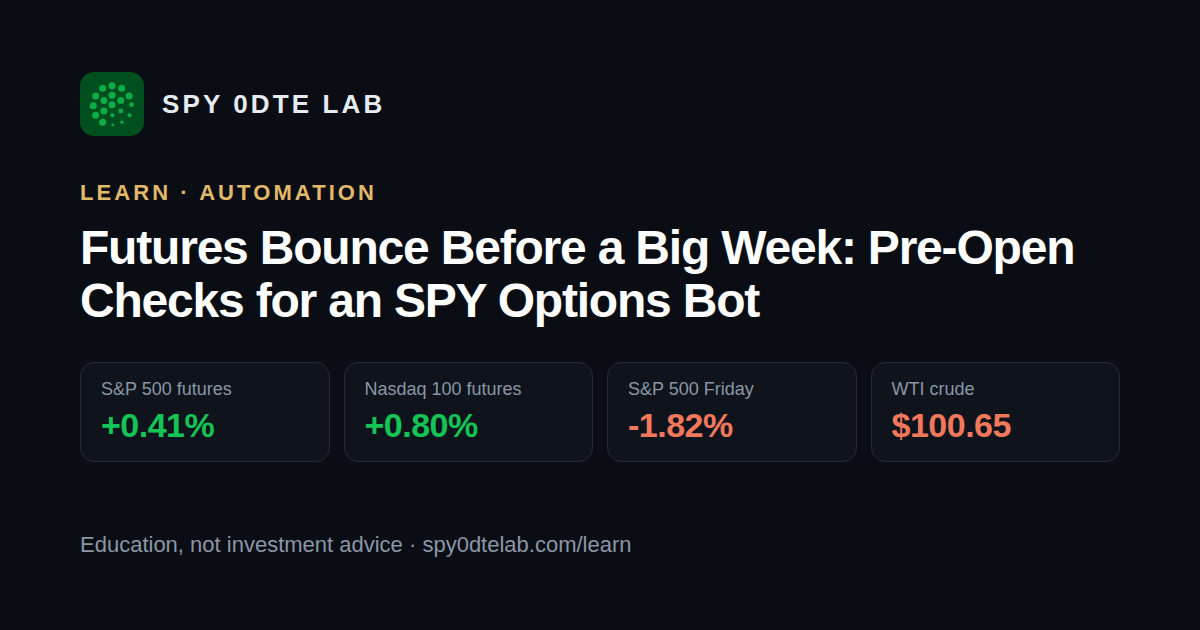
U.S. stock index futures rose on Sunday evening, November 1, after a rough end to October for technology stocks. According to Benzinga, S&P 500 futures were up 31.50 points, or 0.41%, at 7,645.50 by about 8:43 p.m. ET, and Nasdaq 100 futures were up 0.80%. SPY and its options did not trade at all, because it was a Sunday.
For anyone running an automated SPY options strategy, a weekend like this is a test that happens before the first trade. The bot wakes up on Monday to a market that has already moved in futures, a calendar packed with data, earnings and an election, and news feeds that do not always agree. This article walks through what a well-built bot checks before the open, and where money can still be lost.
What moved over the weekend, and what did not
According to a recap published November 1, the S&P 500 fell 1.82% on Friday, October 30, and the Nasdaq Composite lost 2.86%, after disappointing reactions to large technology earnings and a sharp decline in Intel. Another source put Friday's S&P 500 drop at 2.07%. Yahoo Finance described the backdrop as doubts over artificial intelligence spending that hit technology valuations hard in October.
On Sunday evening, futures bounced. Investing.com reported S&P 500 futures up 0.2% at 7,630.75 by 6:18 p.m. ET. Later, Benzinga had them up 0.41%. The numbers differ because they were taken at different times. Oil moved too: WTI crude futures for December delivery dropped 3.31% to $100.65, according to Investing.com. Benzinga's headline said Brent fell to $111 and that President Trump said the Iran war will end one way or the other. Iran's IRNA news agency reported that two oil tankers struck a naval mine in the Strait of Hormuz. Each of those oil and tanker stories comes from a single source.
What did not move: SPY, SPY options and the VIX. The VIX, or Cboe Volatility Index, is a measure of how much movement the market expects in the S&P 500, calculated from option prices. None of them traded on Sunday.
Percent moves. Friday closes come from a November 1 recap. Sunday futures and oil come from Benzinga and Investing.com, taken at different times on Sunday evening.
Why Sunday futures are a hint, not a price
Index futures are contracts on the stock index that trade nearly around the clock, starting Sunday evening. SPY is an exchange-traded fund, and its options trade only in regular weekday hours. A 0.4% rise on Sunday night can grow, shrink or reverse by Monday's open. The difference between Friday's close and Monday's open is called a gap.
For a bot that opens same-day options, the gap shapes the starting point. It changes which strikes sit near the price, how much implied volatility is priced into the options, and how wide the bid-ask spread is. The bid-ask spread is the difference between the best price buyers offer and the best price sellers ask. It is often wider right after the open.
Whether a bot reads futures at all is a design choice. The risk comes from mixing them carelessly, for example computing an overnight change from a stale Friday reference, or comparing a futures level directly with SPY, which trades at a very different price.
There is one weekend risk that same-day trading does not remove on its own. SPY options are American-style and settle into shares. A short option left open at Friday's expiration that finishes in the money can be assigned, which turns it into a stock position that sits through the weekend gap. A bot can check for unexpected share positions before it does anything else on Monday.
A packed calendar, and how a bot can know about it
According to Yahoo Finance and other week-ahead previews, the schedule for the week of November 2 looked like this:
- Monday: ISM Manufacturing for October at 10:00 a.m. ET, with Apple reporting after the close.
- Tuesday: the midterm elections, plus September JOLTS job openings at 10:00 a.m.
- Wednesday: ADP Employment at 8:15 a.m., then ISM Services at 10:00 a.m.
- Friday: the October jobs report, where economists polled by Dow Jones expected 55,000 jobs added.
- Also on the calendar: AMD, Palantir and Qualcomm earnings, plus Fed speakers.
The jobs report carried extra weight. The Fed held rates the week before, with two of its 12 voters backing a hike. Previews noted that a strong jobs report could lift rate-hike odds and add pressure to stocks already weighed down by AI spending doubts.
A bot does not read headlines. It knows only what is in its code and data. Many builders keep an event calendar file with dates, times and event types, and write rules in advance for what the bot does around each type. The key point is timing: the decision is made before the week starts, not in the seconds after a 10:00 a.m. number prints.
The misdated VIX number: a lesson in data checks
While researching this weekend, our brief found a Yahoo Finance quote page saying the VIX rose 12.91% on November 1. That could not be true, because the VIX did not trade on a Sunday. Investing.com lists that same 12.91% gain as Friday's close at 19.42. A human caught the error. A bot pulling that field might have treated it as fresh news.
Wrong data is one of the quietest ways a bot loses money, because the code works exactly as written on a bad input. Common checks include:
- Timestamp check: is the data point stamped on a trading day and at a sensible time?
- Staleness check: is the quote older than a set limit?
- Cross-source check: does a key number match a second, independent feed?
- Sanity bounds: is the move larger than the bot will believe without a second confirmation?
- Quote quality: is there a real bid, and is the spread wide enough to make a fill unreliable?
A pre-open checklist for a Monday like this
- Confirm today is a trading day using an exchange calendar, not a simple weekday test.
- Confirm the broker connection, account permissions and available buying power.
- Look for leftover positions, including shares from any Friday assignment.
- Load the week's event calendar and confirm which rules apply to today.
- Check that every data feed is live, fresh and correctly timestamped.
- Confirm the kill switch is armed and that the manual off button works.
- Confirm logging is on, so every decision and order can be reviewed later.
FINRA retired the pattern day trader rule on June 4, 2026, so the old day-trade count limit no longer applies. Brokers still set their own margin and options approval rules, and a bot can read those from the broker rather than assume them.
Kill switches on a gap-and-data week
A kill switch is code that stops new orders, and sometimes closes open positions, when a condition is hit: a loss limit, a data outage, repeated order errors or a human pressing stop. It is the last line of defense when something unexpected happens.
It has limits. It cannot fill at a price the market skips over. At a gapped open or right after a data release, prices can jump past a trigger level. A market order then fills at whatever bid or ask exists, which can be far from the last price. Money is lost in that gap between trigger and fill, in a defined-risk spread that moves to its full loss before any exit, and in a bot that retries a rejected order in a loop.
An illustration with made-up round numbers, showing a gap up at the open and a sharp swing at a 10:00 data release. It is not a real price path or a forecast.
Two tools help test this before real money is involved. Replay feeds recorded market data through the bot as if it were live, so a past gap day can be run again and again. Paper trading sends simulated orders against live data, which shows how the bot behaves on a real Monday without a real account at risk. Neither shows true fills in a fast market.
Reviewing AI-written code for weeks like this
An AI coding assistant can write a working bot quickly. It can also write confident bugs. This weekend gave a live example: U.S. clocks fell back one hour early on Sunday, November 1, as daylight saving time ended. A bot that stores times in UTC with a fixed offset would think the market opens an hour off from the real 9:30 a.m. New York time.
- Time zones: does the code use New York market time with daylight saving handled by a library?
- Calendars: does it know holidays and early closes, or only weekdays?
- Failures: what happens when a data call times out or returns nothing? Halt, or guess?
- Order states: does it handle partial fills, rejections and cancels correctly?
- Tests: are there replayed days, including a gap open and a data spike, that the code must pass?
A practical review habit is to ask the assistant to explain each function in plain words, write tests for the edge cases above, and point to the broker API documentation it relied on. Then read the code anyway.
How the Iron Condor and SPY 0DTE strategies meet weeks like this
We run two live strategies: the Iron Condor strategy, which sells a call spread and a put spread on SPY to collect a credit and loses when SPY moves far enough in either direction, and the SPY 0DTE strategy, a separate same-day SPY options strategy. Entries follow fixed rules on live data in a real-money account. Days with scheduled data, earnings or elections are handled by rules fixed in advance, not decided on Sunday night from a futures quote. Exits are our own decisions, and every closed trade is on the public record.
For traders who want to build and run their own version with an AI coding assistant and a broker API, we publish the Iron Condor Auto-Trading Prompt and the SPY 0DTE Auto-Trading Prompt, PDFs at $899 each. A bot built from either one can still lose money, and every check in this article applies to it as much as to any other bot.
Frequently asked questions
Do SPY options trade on Sunday evening?
No. SPY options trade only during regular U.S. market hours on weekdays. What trades on Sunday evening are stock index futures, which can hint at where SPY may open on Monday. That hint can grow, shrink or reverse before the open.
What is a weekend gap, and why does it matter for 0DTE trading?
A gap is when the opening price differs from the previous close. A same-day options position is not held over the weekend, so the gap does not hit an open 0DTE trade directly. But the gap shapes Monday's starting prices, implied volatility and bid-ask spreads, which affect any new same-day trade.
What is a kill switch in an options bot?
It is a piece of code that stops the bot from sending new orders, and sometimes closes open positions, when a set condition is met, such as a loss limit, a data outage or repeated errors. It also usually includes a manual off button. It limits damage, but it cannot guarantee a fill price in a fast market.
How can a bot avoid acting on wrong or stale data?
Common checks include comparing each data point's timestamp to the market calendar, rejecting quotes that are too old, cross-checking key numbers against a second source and setting sanity limits on how far a value can move. None of these is perfect, but each catches a different kind of error before it reaches an order.
Does the pattern day trader rule still limit how often a small account can day trade?
FINRA retired the pattern day trader rule on June 4, 2026, so the old day-trade count limit no longer applies. Brokers still set their own margin requirements, options approval levels and account rules. A bot can read those from the broker rather than assume them.
This article is general, educational information, not investment advice or a recommendation to buy or sell any security. Options, especially same-day options, involve substantial risk and can lose their full value within minutes. Past results do not guarantee future results. Read the Risk Disclosure.