
SPY 0DTE Iron Condors and a VIX Above 20: Lessons From a Faded Rally
The S&P 500 gave back a 1.1% gain and closed lower as the VIX rose above 20. Here is what a faded rally means for SPY 0DTE iron condors, premium, the Greeks and risk.
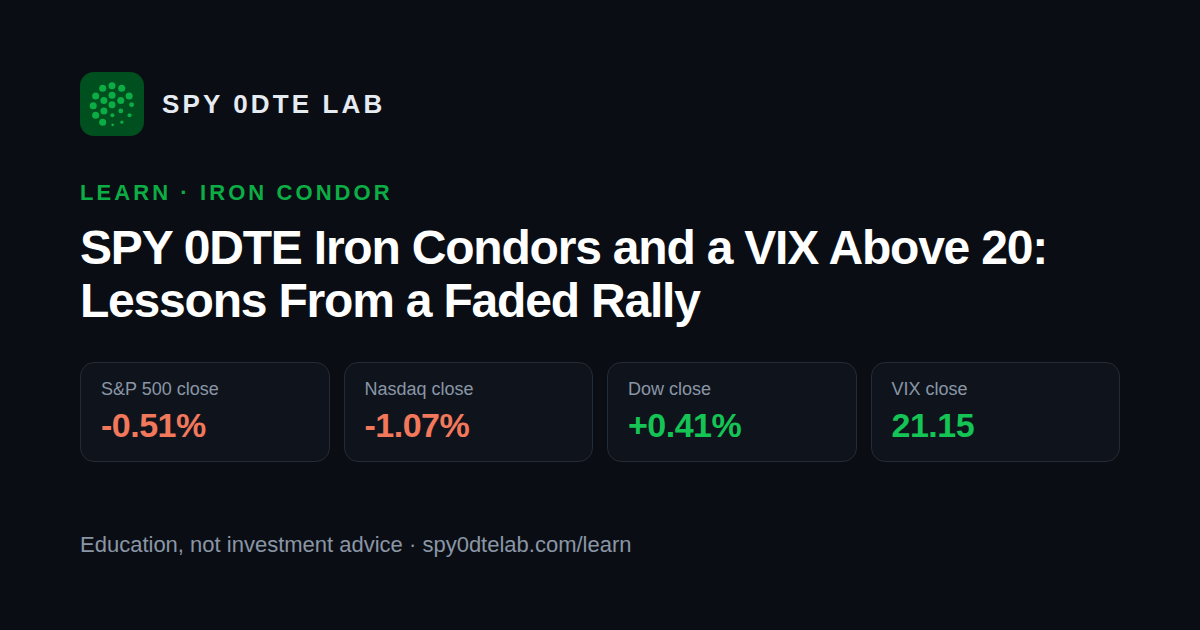
On Monday, November 2, 2026, the stock market gave back an early rally. According to CNBC, the S&P 500 and the Nasdaq were up as much as 1.1% and 1.4% before tech selling returned. The S&P 500 closed down 0.51% at 7,541.40, and the Nasdaq fell 1.07% to 25,164.32. The Dow rose 0.41% to 51,983.98. The VIX, the best-known gauge of expected stock market volatility, closed at 21.15, up 8.91%, according to Kaohoon International.
For anyone who sells SPY options that expire the same day, this was an instructive session. Price went up, then came down, and the volatility index crossed a level that Cboe calls cautious. This article explains what a faded rally does to a 0DTE iron condor, what a VIX above 20 changes for premium sellers, and where the money is lost.
What happened on Monday: a rally that faded
The morning started strong. Oil fell about 7.6% on hopes for US-Iran peace talks, according to Stocktitan citing CNBC, and the Motley Fool. Lower oil lifted cyclical stocks and the Dow. Gold rose about 2%, and the 10-year Treasury yield was near 4.94% at midday, according to the Motley Fool.
Tech did not join the rally for long. Yahoo Finance's live blog says the S&P 500 was still up 0.5% at about 2:40 p.m. ET before the gain faded in the afternoon. Oracle fell about 8% after announcing plans to raise $10 billion in stock and $10 billion in bonds to pay for its AI buildout, according to CNBC and Yahoo Finance. Marvell agreed to buy Lumentum in a $115 billion deal, and Marvell fell almost 13% while Lumentum fell 18%.
This came after heavy tech selling on Thursday and Friday, driven by doubts about AI spending. According to Yahoo Finance and Zacks, that left the Nasdaq with its worst month since March 2025. From its high to its close, the S&P 500 swung roughly 1.6 percentage points on Monday.
Peak gains and closing changes for the major US indexes. Source: CNBC, as summarized in the research brief.
Why a faded rally tests both sides of an iron condor
An iron condor is a four-option trade. The seller sells a call spread above the current price and a put spread below it, and collects a credit, which is cash received up front. A spread pairs a short option with a cheaper long option further out, which caps the loss. The short strikes are the prices the seller does not want crossed. If price ends between them at expiration, the seller keeps the credit.
A trend day attacks one side. A reversal day like Monday can attack both. In the morning the call side loses value for the seller as price climbs toward the short call. In the afternoon the pressure moves to the put side. The close can still land inside the range. But the trade can show a loss at several points along the way.
Illustration only, with round made-up numbers. It shows how a session can rally about 1% and then close below its open, testing an upper level in the morning and a lower one late in the day.
The practical lesson is about exits. A trader who closes the call side near the morning high locks in that loss. If price then falls toward the put side, the remaining half of the trade is now at risk too. Two separate losses in one day are possible on a round-trip session. Holding to the close avoids locking in the swing, but it also accepts the full maximum loss if the move keeps going.
VIX above 20: what a higher volatility regime changes
The VIX measures the volatility that S&P 500 options are pricing over roughly the next 30 days. It closed at 21.15 on Monday after Friday's 19.42. Cboe describes the area above 20 as cautious. Traders often call these bands volatility regimes: calm, cautious, stressed.
For a premium seller, a higher VIX cuts both ways. Options cost more, so the same strikes bring in a larger credit. But the market is also pricing larger moves. The expected move, the range the options market implies for a period, gets wider. A common rule of thumb divides the VIX by about 16 for a rough one-day move. For example, 21 divided by 16 is about 1.3%. Monday's swing of about 1.6 points from high to close was larger than that.
- More credit means more cushion before the trade loses money at expiry.
- Wider expected moves mean strikes at a fixed distance are more likely to be touched.
- Vega, the sensitivity to implied volatility, works against a short condor if volatility keeps rising during the day.
- The VIX is a 30-day measure; same-day options can price a different volatility.
The Greeks when the market turns late in the day
Theta is the daily time decay that short options earn. On expiration day it is at its fastest, which is why sellers like 0DTE. Gamma is how fast delta, the option's sensitivity to price, changes. Near expiry, gamma for options close to the money is very high.
That matters on a day like Monday because the turn came in the afternoon. With only an hour or two left, a short strike that sat comfortably away from price can become close to the money quickly. High gamma means its value can jump in minutes. Theta helps the seller as the clock runs, but a fast move can outrun it. Late-day reversals are where small gains most often turn into large losses.
A busy week of event risk ahead
The calendar this week is crowded. Tuesday, November 3, brings the US midterm elections, according to Yahoo Finance and Gotrade. Apple and Palantir reported after Monday's close. MacRumors says Apple posted $114.5 billion in revenue, up 12%. Its after-hours move was mixed: AppleInsider showed it rising, while 9to5Mac said it fell as much as 4.43% before recovering some of that. Stocktitan reported futures little changed late in the evening.
Later in the week, AMD and Airbnb report among 138 S&P 500 companies, according to Gotrade citing CNBC. On Friday, November 6, at 8:30 a.m. ET, the October jobs report arrives. RoboForex says the forecast is about 40,000 jobs with unemployment unchanged. The Fed is holding rates at 3.75% to 4%.
A 0DTE trade opened and closed on the same day carries no overnight risk. But overnight news still sets the open. A gap at the open moves the center of the day, and implied volatility on event days is often priced higher before the news and lower after it. A seller collects that extra premium only by accepting the chance of a large move.
Defined risk, settlement and where the money is lost
An iron condor is called defined risk because the long options cap the loss. The maximum loss on one side is the spread width minus the credit. The line chart below shows a payoff at expiry with round made-up numbers: 5-dollar wide spreads and a 1.50 credit. The seller can keep 150 dollars, but can lose 350 dollars per condor.
Illustration with round made-up numbers: short strikes at 495 and 505, long strikes at 490 and 510, credit of 1.50, per one-contract condor. Not a real trade.
The shape shows the trade-off. Many days end in the flat middle. A few days end past a short strike, and one of those can erase several winning days. Settlement adds another layer. SPY options are American-style and settle into shares. A short option can be exercised early, and a short leg in the money at the close can be assigned, leaving a share position after the bell. Closing positions before the end of the session is how many traders avoid that.
One rule change is also worth knowing. FINRA retired the pattern day trader rule on June 4, 2026, so the old minimum-equity limit on frequent day trades no longer applies. Broker margin and options approval rules still do.
How the Iron Condor strategy meets days like this
The Iron Condor strategy is our automated approach to SPY same-day iron condors and credit spreads. Its entries follow fixed rules on live data in a real-money account. Exits are our own decisions. Every closed trade, winning or losing, is on the public record.
Reversal days, a VIX crossing 20, election days and jobs report mornings are all handled by rules fixed in advance, not by reacting to headlines on the day. That does not remove risk; the losses described above are part of the record. The rules behind the strategy are set out in the Iron Condor Playbook, a PDF for readers who want to study how a rule-based approach to this style of trading is built.
Frequently asked questions
What is an iron condor?
An iron condor is four options on the same expiration. You sell a call spread above the price and a put spread below it and collect a credit. If the price stays between the two short strikes at expiration, you keep the credit. If it moves past either short strike, losses grow up to a fixed maximum.
Why does a faded rally matter for a 0DTE iron condor?
A faded rally first pushes price toward the call side, then back down toward the put side. Each side can show a loss at different times of the same day. The close may land inside the range, but anyone who exits during the swing locks in the loss shown at that moment.
Does a VIX above 20 make iron condors safer or riskier?
Neither, by itself. A higher VIX means options cost more, so sellers collect more credit. It also means the market expects bigger moves, so strikes at the same distance are more likely to be tested. Higher credit is payment for higher risk, not a free gain.
Is the VIX the same as same-day implied volatility?
No. The VIX measures expected volatility of S&P 500 options over about 30 days. Same-day options have their own implied volatility, which can be higher or lower than the VIX. The VIX is a useful backdrop, but it does not price a single session.
Can a SPY 0DTE iron condor be assigned?
Yes. SPY options are American-style and settle into shares, so a short option can be exercised early, and any short leg in the money at the close can be assigned. The long leg of the spread does not exercise on its own unless it is in the money or you instruct it. That is why settlement needs watching on expiration day.
This article is general, educational information, not investment advice or a recommendation to buy or sell any security. Options, especially same-day options, involve substantial risk and can lose their full value within minutes. Past results do not guarantee future results. Read the Risk Disclosure.