
SPY 0DTE on Midterm Election Day: When the Big News Comes After the Bell
Stocks rose on a chip rebound on Election Day, then futures fell after the close as midterm results came in. What that timing means for buyers of same-day SPY calls and puts.
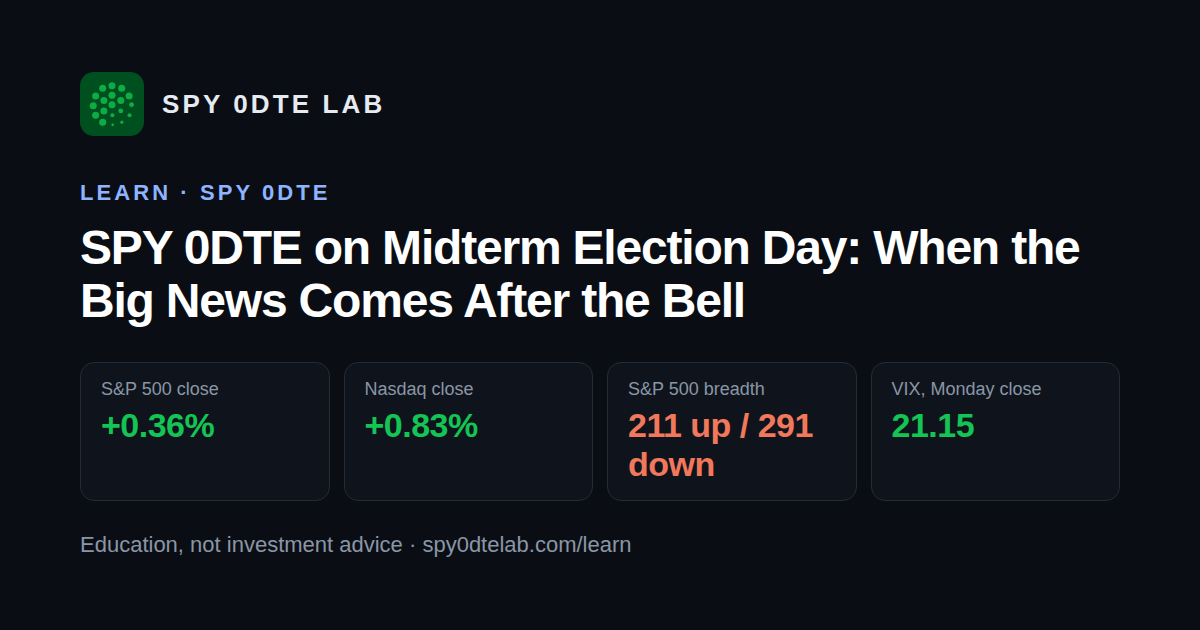
Tuesday, November 3, 2026, was Midterm Election Day in the United States. During regular hours, though, the market was driven by chip stocks, not ballots. According to CNBC, the S&P 500 climbed 0.36% to 7,568.92, ending a three-day losing run, and the Nasdaq rose 0.83% to 25,372.01. Then, after the closing bell, stock futures turned lower as traders bet on big Democratic wins, CNBC reported at 7:48 p.m. ET.
For anyone who buys same-day SPY options, the timing is the lesson. The day's biggest news landed after every option expiring that day had already stopped trading. This article looks at what that means: overnight risk, the price of volatility in an event week, narrow rallies and the discipline of fast losses.
What happened on Election Day
Chip stocks bounced back from what CNBC described as a fresh bear market, while Wall Street's safe havens slipped. Not everything rose. The Dow fell 197 points, weighed down by Apple after a disappointing profit margin forecast, CNBC reported. Apple ended the session about $94 billion below its market value at Monday's close.
After the close, the story changed. CNBC reported that S&P futures opened 0.2% higher before coming under pressure as midterm results came in, and that VIX futures moved higher, with its headline noting a move above 20. The VIX is the Cboe Volatility Index, a gauge of how much movement options traders expect in the S&P 500. Fox Business said futures tumbled and that the Fox News Decision Desk projected Democrats would take control of both chambers of Congress. The two outlets differ on the timing and size of the futures drop, so the exact move is unclear.
Also after the bell, AMD and Arista Networks jumped on sales above their own forecasts, according to the day's coverage. So the evening held both political news and earnings news, all of it outside regular trading hours.
Why a same-day option cannot hold an overnight event
A 0DTE option is one with zero days to expiration: it expires on the day it is traded. For SPY options expiring that day, trading ends at the 4 PM ET close. Whatever happens at 7:48 p.m. cannot change the value of a contract that has already expired.
There is one important exception. SPY options are American-style and settle into shares, not cash. An option that finishes in the money, meaning it has value at expiration, is usually exercised automatically. A long call becomes 100 shares of SPY per contract, bought at the strike price. A long put becomes 100 shares sold short per contract. Those shares are a new position, and they are exposed to whatever happens overnight.
- A long call that expires slightly in the money turns into a share position worth tens of thousands of dollars per contract at today's SPY prices.
- If futures fall in the evening, as they did on election night, that share position can open lower the next morning.
- The account must have the buying power to hold the shares, or the broker may act on its own to reduce the position.
- Many traders close in-the-money options before the bell for exactly this reason, but that is a choice with its own cost: giving up any last-minute move.
So the plain answer is that a same-day option buyer does not get exposure to election-night news unless the trade turns into shares. And if it does, the risk profile changes completely: the loss is no longer capped at the premium paid.
Event weeks make options more expensive
Option prices include implied volatility, the market's estimate of how far prices may swing. When a known event falls inside an option's life, that estimate rises and so does the price. According to Saxo, the VIX stood at 21.15 at Monday's close, and a nine-day volatility gauge that covers the midterm vote, Wednesday's Treasury refunding and Friday's payrolls jumped 16.68% to 22.46 on Monday.
The VIX and the nine-day volatility gauge at Monday's close, according to Saxo. The shorter gauge sat higher because it covers this week's events.
For a buyer, higher implied volatility means paying more for the same strike. It also means the option loses more value per hour if nothing happens. That hourly loss is called theta, or time decay. On expiration day, theta speeds up into the close, because every passing hour removes a bigger share of the time the option has left.
On a day when the big catalyst is scheduled after the close, a buyer of a same-day option is paying event-week prices for a contract that will not be alive when the event arrives. If the market drifts while waiting, decay does the damage. The chart below shows the general shape with made-up numbers.
Illustration with round, made-up numbers: the value of an at-the-money same-day call if the underlying price does not move. Decay is slow in the morning and fast into the close.
A narrow rally: the index rose, most stocks fell
Breadth measures how many stocks rise versus fall. On Election Day it was weak even though the index finished higher. According to the day's coverage, 291 S&P 500 stocks closed in the red and 211 in positive territory. Chips carried the index, while Apple dragged on the Dow.
Number of S&P 500 stocks that closed higher and lower on Election Day, from the day's market coverage.
Why does this matter to someone trading SPY calls and puts? Same-day buyers usually need a trend day, a session where price keeps moving in one direction. A chop day, where price swings back and forth, tends to eat premium on both sides. When a few heavy stocks pull the index up while most stocks slip, the tape can be uneven: a push higher, a stall, a pullback, another push.
Many traders read context tools on such days. VWAP, the volume-weighted average price, shows the average price paid during the session; price holding above it is often read as buyers in control. Moving averages smooth recent prices to show direction. A breakout, a move through a recent high or low, can mark the start of a trend. None of these tools predicts anything. They describe what price has done, and on narrow days they often give mixed signals.
Fast losses and sizing by risk
Buying a same-day option risks the entire premium. Because gamma, the rate at which an option's sensitivity to price changes, is very high on expiration day, a modest move against the position can cut its value in half within minutes. A move in favor can do the opposite. That speed is the appeal and the danger.
Sizing by risk means deciding first how much money a single trade may lose, and then choosing the number of contracts from that figure, not from how confident the trade feels. On a 0DTE buy, the worst case is usually the full premium, unless the option is exercised into shares, in which case the loss is no longer capped.
- Fast losses invite revenge trades, where a trader buys again right away to win the money back.
- Since FINRA retired the pattern day trader rule on 2026-06-04, there is no outside limit on day-trade frequency in small margin accounts, so any brake has to be self-imposed.
- Event days add a temptation to hold into the close for a catalyst that may arrive after expiration, which is exactly the trap election day showed.
- Writing limits down before the open, such as a maximum loss per day, removes some decisions from the heat of the moment.
What comes next this week
Election Day was only the first of several events. Saxo flagged Wednesday's Treasury refunding and Friday's payrolls report as further volatility events. AI-related earnings are also in focus, with AMD and Super Micro Computer named in the day's coverage. JPMorgan expects roughly a 0.5% S&P 500 decline if Democrats sweep Congress, according to market reports on the day.
For same-day option buyers, the general point holds beyond this week. Some catalysts land during the session, where a 0DTE contract can react to them. Others land in the evening or before the open, where only overnight positions are exposed. Knowing which is which, before buying, is part of understanding what a premium actually pays for.
How the SPY 0DTE strategy meets days like this
The SPY 0DTE strategy buys same-day SPY calls and puts in a real-money account. Its entries follow fixed rules applied to live market data, and its exits are our own decisions. Every closed trade is published on the public record, wins and losses alike.
Election days, data releases, earnings nights and high-volatility weeks are handled by rules fixed in advance, not by forecasts made on the day. We do not describe those rules here, and nothing in this article is a recommendation to trade. The SPY 0DTE Playbook, a PDF, explains the approach behind the strategy for readers who want to study it in depth. Same-day option buying can lose the full premium quickly, and no set of rules removes that risk.
Frequently asked questions
Can a 0DTE SPY option profit from election results announced in the evening?
Not as an option. Trading in expiring SPY options ends at the regular close, and any value left is settled by exercise or the contract expires worthless. If an in-the-money option is exercised, the holder ends up with SPY shares, and those shares, not the option, carry the overnight move.
What happens to an in-the-money SPY call at expiration?
SPY options are American-style and settle into shares. An in-the-money call is usually exercised automatically, which turns each contract into 100 SPY shares bought at the strike price. That position needs enough buying power and is exposed to any move before the next open.
Why do options get more expensive before an election?
Option prices include implied volatility, the market's estimate of how much prices will swing. When a known event sits inside an option's life, sellers ask for more premium. According to Saxo, a nine-day volatility gauge covering the vote, the Treasury refunding and payrolls jumped 16.68% to 22.46 on Monday.
What does a narrow rally mean for same-day option buyers?
A narrow rally is an index gain driven by a small group of stocks while most stocks fall. On Election Day, chips led while 291 S&P 500 stocks closed lower and 211 higher. Such days can look like a trend on the index chart but trade in a choppier way, which can hurt buyers who need a steady move.
Does the pattern day trader rule still limit how often I can trade 0DTE options?
No. FINRA retired the pattern day trader rule on 2026-06-04. That removes an outside brake on trade frequency, so any limit on how many trades are taken now has to come from the trader's own rules.
This article is general, educational information, not investment advice or a recommendation to buy or sell any security. Options, especially same-day options, involve substantial risk and can lose their full value within minutes. Past results do not guarantee future results. Read the Risk Disclosure.